CM Punjab Rehmat Card Program 2026 – Online Registration, Eligibility & Benefits
Every day, thousands of widows in Punjab wake up without financial support. They have children to feed, schools to pay for, and no steady income. The state has finally decided to step in.
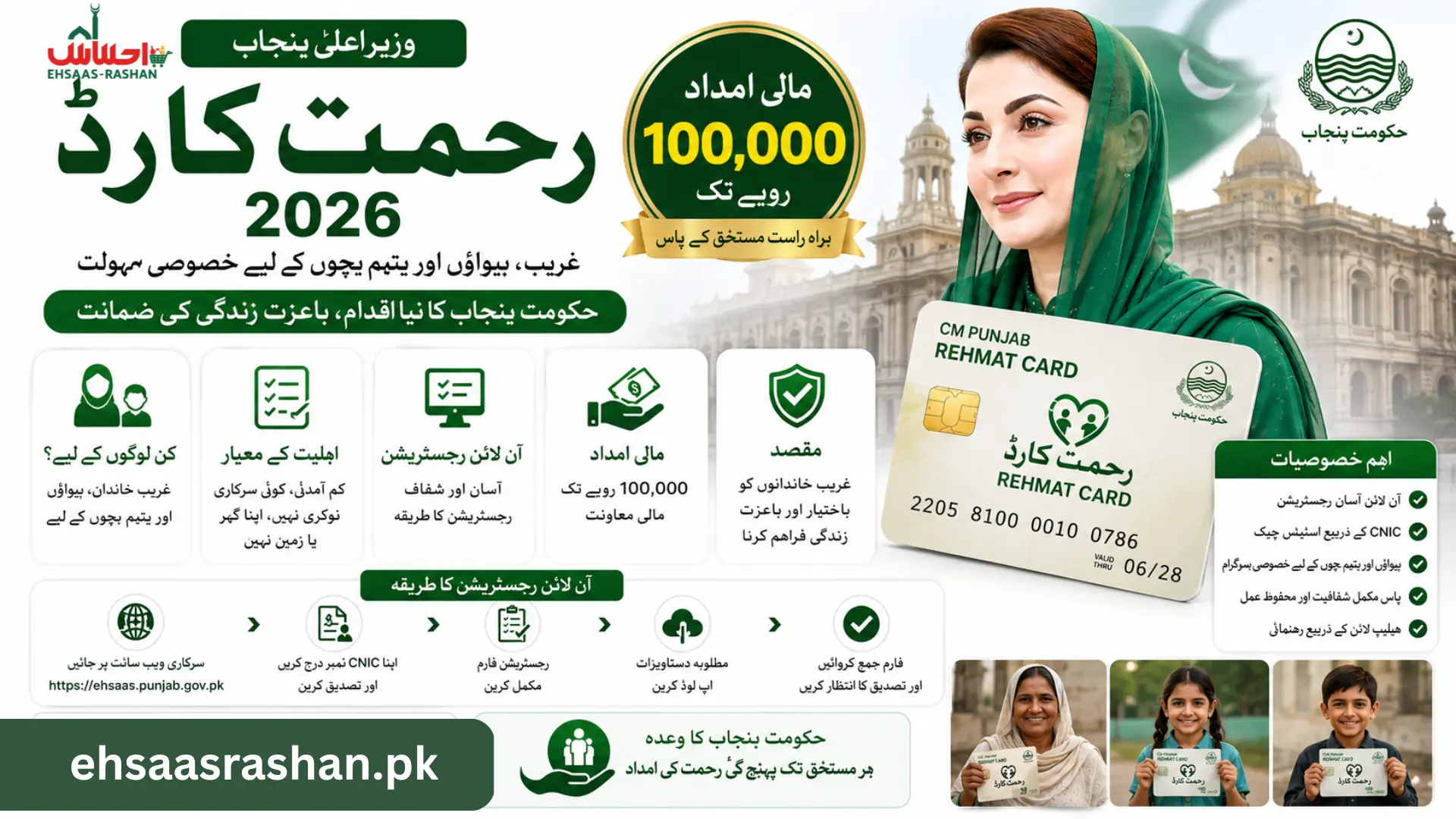
Chief Minister Maryam Nawaz Sharif officially approved the CM Punjab Rehmat Card on 5 March 2026. The program provides direct financial grants to widows and orphaned children across Punjab. It is designed not as charity, but as state patronage Sarkari Kafalat.
What Is the Rehmat Card Program?
The CM Punjab Rehmat Card is a targeted financial assistance program launched by the Government of Punjab. The scheme provides direct cash grants to widows (Bewa) and orphaned children (Yateem) who have lost their primary earner and are facing economic hardship.
The program operates through a fully digital system. It uses PSER (Punjab Socio-Economic Registry), NADRA, and BISP databases to identify genuinely deserving families. No middleman is involved. Funds are transferred directly to the beneficiary’s bank account or mobile wallet.
The initiative covers 36 districts of Punjab with a target of 40 lakh+ beneficiaries in multiple phases. If you want to get information about more schemes, then click the given button below;
Main Objective of the Program
The primary goal is to provide financial independence to vulnerable families. Many widows in Punjab struggle to meet daily expenses after losing their husbands. Orphaned children often drop out of school due to poverty. The Rehmat Card addresses both crises directly.
- Provide immediate financial relief to widows and orphaned children.
- Enable widows to start small businesses and become financially self-reliant.
- Support orphans’ education, healthcare, and daily living costs.
- Eliminate the need for charity through formal state-backed social protection.
- Reduce poverty and improve living standards across Punjab’s vulnerable communities.
Key Features of the Rehmat Card
The Rehmat Card is built on a transparent, technology-driven platform with the following core features.
- Monthly assistance of Rs. 10,500 per eligible family on a recurring basis.
- One-time grant of Rs. 100,000 for widows and Rs. 25,000 per orphan child.
- Total assistance can reach up to Rs. 150,000 for larger families.
- Automatic eligibility check through PSER database.
- CNIC-based instant status verification via NADRA.
- Direct digital disbursement, no cash agents, no corruption.
- Covers all 36 districts of Punjab province.
- 30% quota reserved for women beneficiaries.
Quick Scheme Overview
| Program Name | CM Punjab Rehmat Card 2026 |
| Also Known As | Bewa Sahara Card / Yateem Card |
| Launched By | Government of Punjab |
| Leadership | Chief Minister Maryam Nawaz Sharif |
| Approval Date | 5 March 2026 |
| Helpline Number | 0800-02345 (Toll-Free) |
| Official Portal | punjab.gov.pk / PSER portal |
| Monthly Assistance | Rs. 10,500 |
| One-Time Grant (Widow) | Rs. 100,000 |
| Grant Per Orphan Child | Rs. 25,000 |
| Maximum Total Grant | Rs. 150,000 |
| Target Beneficiaries | 40 Lakh+ families |
| Districts Covered | 36 districts across Punjab |
| Payment Method | Bank transfer / HBL Konnect / JazzCash / Easypaisa |
| PMT Score Required | Low poverty score (PSER/BISP registered families get priority) |
Rehmat Card Program Registration Process
The Punjab Government has designed three easy ways to register. You can apply online, through SMS, or by visiting a local registration center. Choose the method that works best for you.
How to Apply Online
Rehmat Card online registration is the fastest and most convenient method. You do not need to visit any office. Follow these steps carefully.
- Open your browser and go to the official Punjab Government portal or PSER website.
- Click on the Rehmat Card or Bewa / Yateem Card registration option.
- Enter your 13-digit CNIC number without dashes.
- Enter the mobile number registered in your name for OTP verification.
- Fill in your full name as registered with NADRA.
- Provide complete household details, including family size and number of dependent children.
- Upload a scanned copy of your CNIC (front and back).
- Upload the husband’s NADRA-verified death certificate (for widow applicants).
- Upload the child’s B-Form and death certificate (for orphan applicants).
- Declare your monthly household income and residential address.
- Double-check all information for accuracy. Errors cause delays.
- Click Submit. You will receive a confirmation SMS with your application tracking ID.
Keep your tracking ID safe. You will use it to monitor your application status at every stage.
Registration Through SMS
If you do not have internet access, the SMS method is quick and simple.
1. Open the SMS or messaging app on your mobile phone.
2. Type your 13-digit CNIC number without spaces or dashes.
3. Send it to 8171. You will receive a reply about your PSER registration and eligibility.
4. If you are already registered in the PSER database, your status will be confirmed automatically.
5. If not registered, you will receive instructions on how to complete your PSER survey first.
Note: Your mobile number must be registered in your own name. Otherwise, the SMS verification will fail. Visit a Ufone, Telenor, Jazz, or Zong franchise to update your SIM registration if needed.
Registration Through Local Centers
If you cannot apply online or through SMS, visit any of the following in-person points.
- District Zakat and Ushr Offices, available in all 36 districts of Punjab.
- Tehsil-level Social Welfare Offices, for rural and semi-urban applicants.
- e-Khidmat Markazs, government facilitation centers in most cities.
- ACAG Registration Centers, can assist with Rehmat Card registration too.
- Union Council offices, for community-level PSER survey registration.
At any of these centers, bring your original CNIC, death certificate, B-Form (for orphan cases), and two passport-size photographs. Trained government staff will fill out the form and complete biometric verification on your behalf.
Eligibility Criteria for Rehmat Card Program
The Punjab Government has set strict eligibility conditions to ensure the program reaches the most deserving families. Read each condition carefully before applying.
Who Can Apply?
• Widow women — must be permanent residents of Punjab with marital status updated as Widow in their NADRA CNIC.
• Orphaned children — must be under 18 years of age and have lost their father or both parents.
• Low-income families — registered in PSER or BISP with a low PMT (Poverty Means Test) poverty score.
• Unemployed individuals — with no regular income source and facing financial hardship.
• Persons with disabilities — considered under the broader welfare umbrella alongside Himmat Card support.
• All applicants must be permanent residents of Punjab province with valid CNIC proof of residency.
• Applicants must be the head of the household or the legal guardian as per NADRA records.
Who Is Not Eligible?
• Government employees — federal, provincial, or municipal employees do not qualify.
• Income tax filers with taxable income — individuals with declared high income are excluded.
• Overseas Pakistanis — applicants must be physically residing in Punjab.
• People already receiving full government salaries or pensions.
• Families owning significant assets like businesses, large agricultural land, or multiple properties.
• Applicants with incorrect or mismatched CNIC details in NADRA database.
Required Documents
Prepare the following documents before starting your registration. All documents must be original and valid.
• Original and photocopy of CNIC (applicant’s CNIC must be updated with correct marital status in NADRA).
• NADRA-verified death certificate of the husband (for widow applicants).
• Child’s B-Form and death certificate of parent(s) (for orphan cases).
• Proof of residence, domicile certificate or utility bill.
• Income certificate from Union Council (for low-income applicants).
• Two recent passport-size photographs.
• Bank account details or JazzCash / Easypaisa account number for payment.
• Registered mobile number, must be in the applicant’s own name.
Pro Tip: If your husband’s death certificate is not computerized, visit your local Union Council immediately. Manual certificates must be digitized through NADRA before the PSER portal will accept them.
Rehmat Card Program Benefits
The Rehmat Card offers multiple layers of financial and social support. Here is a full breakdown.
Financial Assistance
The Rehmat Card provides one of the highest government grants in Punjab’s welfare history.
- Widows receive a one-time cash grant of Rs. 100,000 as base financial support.
- Each orphaned child in the family receives an additional Rs. 25,000.
- Families with two or more orphan children can receive total grants of up to Rs. 150,000.
- Monthly recurring assistance of Rs. 10,500 is available for eligible registered families.
- A 3-month grace period is provided before repayment applies to any loan-linked support.
- Emergency relief is also available for families facing sudden crises such as medical emergencies or natural disasters.
This capital is designed to help widows start small businesses and achieve long-term financial independence rather than relying on short-term aid.
Subsidy and Discounts
- Food ration subsidy — eligible families can receive discounted or free essential groceries.
- Utility bill support — partial relief on electricity and gas bills for low-income households.
- Medical support — priority access to government hospitals and free medicines for registered families.
- Educational support — orphan children receive grants specifically to cover school fees and supplies.
- The Rehmat Card is linked to the broader Punjab welfare ecosystem including the Ration Card, Himmat Card, and Kissan Card programs.
Digital Card Features
The Rehmat Card is a fully digital smart card with multiple usage features.
- ATM withdrawal — funds can be accessed at any Bank of Punjab or HBL Konnect ATM.
- Mobile wallet withdrawal — JazzCash and Easypaisa are both supported for fund access.
- Balance check — check your available balance by SMS or through your bank’s mobile app.
- Secure biometric authentication — thumbprint verification prevents fraud and unauthorized withdrawals.
- Real-time payment notifications — you receive an SMS the moment your payment is processed.
How to Check Rehmat Card Status
After submitting your application, track your progress using your CNIC. Here are all available methods.
Online Status Check
1. Go to the official portal or the Rehmat Card government portal.
2. Click on the ‘Check Application Status’ section.
3. Enter your 13-digit CNIC number without dashes or spaces.
4. Enter your registered mobile number for OTP confirmation.
5. Click Submit. Your current application status will appear on the screen.
Log in to your registered account dashboard for more detailed tracking. The dashboard shows your verification stage, PMT score, and payment history.
SMS Status Check
1. Open your phone’s messaging app.
2. Type your 13-digit CNIC number.
3. Send it to 8171.
4. You will receive a reply confirming your PSER registration status and Rehmat Card eligibility.
Keep your registered mobile number active throughout the process. All official government updates are sent via SMS.
Common Status Messages
- Registered: Your application has been submitted successfully and is under initial review.
- Under Verification: NADRA, PLRA, and PSER cross-checks are in progress.
- Approved: You meet all eligibility criteria. Your payment will be processed shortly.
- Selected for Payment: Your disbursement has been scheduled. Expect an SMS with the payment date.
- Rejected: Your application did not meet one or more eligibility conditions. Reasons will be specified.
- Documents Incomplete: You are required to submit missing documents to proceed.
If your application is rejected, review the reason carefully. You may reapply in the next phase after correcting the issue.
Rehmat Card Payment Details
Understanding the payment structure helps you plan your finances and know what to expect after approval.
Payment Amount
The Rehmat Card offers two types of financial support based on your situation.
- One-Time Capital Grant — Rs. 100,000 for widows plus Rs. 25,000 per orphan child (up to Rs. 150,000 total).
- Monthly Recurring Assistance — Rs. 10,500 per month for families registered in the welfare database.
- The one-time grant is designed to help widows start small businesses or cover long-term household needs.
- Monthly payments provide ongoing support for daily expenses, food, healthcare, and education.
Payment Schedule
- Phase 1 payments cover the first 50,000 families and are expected to begin shortly after Eid 2026.
- Approved applicants will receive an official SMS notification with their exact payment date.
- Monthly payments are released on a quarterly cycle for recurring assistance beneficiaries.
- Check your dashboard or call helpline 0800-02345 for your specific disbursement schedule.
Withdrawal Methods
- ATM Withdrawal: visit any Bank of Punjab or HBL Konnect ATM with your biometric card.
- JazzCash: receive and withdraw funds directly through your JazzCash mobile account.
- Easypaisa: Easypaisa accounts linked to your CNIC are also supported for withdrawal.
- Bank Transfer: funds can be transferred directly to your existing bank account.
- Camp-Based Distribution: the government also organizes dedicated payment camps in rural areas for convenience.
Always carry your original CNIC for biometric verification when withdrawing from a camp or physical center.
Common Problems and Solutions
Many applicants face technical or administrative issues during or after registration. Here is how to resolve the most common ones.
CNIC Not Found
This usually means your CNIC details in the NADRA database do not match. Visit your nearest NADRA office to update your information. Make sure your marital status, address, and family details are current. CNIC renewal takes 1 to 3 working days.
Application Rejected
Rejections happen when eligibility conditions are not fully met. Review the rejection reason on your dashboard. Check whether your PMT score is too high, your documents are incomplete, or your marital status is not updated in NADRA. Correct the issue and reapply in the next registration phase.
SMS Not Working
If you receive no response after sending your CNIC to 8171, your SIM may not be registered in your name. Visit your mobile network franchise with your original CNIC to re-register the SIM. The system only recognizes mobile numbers linked to your CNIC.
Payment Delay Issues
Payment delays can occur due to high application volumes or incomplete biometric verification. Visit your nearest e-Khidmat Markaz with your original CNIC to complete thumbprint verification. Once biometric data is confirmed, payments are released within 3 to 7 working days.
Biometric Verification Failed
Biometric failure often affects elderly applicants or those with worn fingerprints. Visit the nearest District Social Welfare Office and request manual verification. A government officer will assist with alternative identity confirmation. Do not visit unauthorized centers offering paid biometric services.
Rehmat Card Program Helpline and Support
Official Helpline Number
The Punjab Government has set up a dedicated toll-free helpline for Rehmat Card support.
• Toll-Free Helpline: 0800-02345
• Available during official government working hours.
• Call for registration assistance, status queries, payment issues, and eligibility questions.
• A representative will guide you through the process in Urdu and Punjabi.
Complaint Registration
If you face an unresolved issue, file a formal complaint through these official channels.
• Online Complaint Portal — visit the PSER or Rehmat Card official portal and open the Complaints section.
• Fill in your CNIC, contact number, and a brief description of the issue.
• Attach any supporting documents or screenshots to strengthen your complaint.
• You will receive a complaint reference number. Use it to track resolution progress.
• Helpline — call 0800-02345 and ask for the complaints team.
Nearest Assistance Centers
Latest Updates About Rehmat Card Program 2026
New Registration Phase
Registration for Phase 1 officially opened after Eid 2026. The first 50,000 families are being onboarded across all 36 districts. Families not included in Phase 1 will be registered in upcoming phases. Check the official portal regularly for Phase 2 announcements.
Increased Financial Aid
The Punjab Government revised the financial package upward compared to earlier announcements. The total assistance per family can now reach Rs. 150,000 for widows with multiple orphan children. This represents one of the highest one-time welfare grants in Punjab’s history.
Government Announcements
Chief Minister Maryam Nawaz has emphasized a strict No Middleman policy. All disbursements are digital. The government has also announced integration of the Rehmat Card with the broader Sarkari Kafalat (State Patronage) system, allowing one card to access multiple welfare programs in future phases.
New Cities Added
The program now covers all 36 districts including Lahore, Faisalabad, Multan, Rawalpindi, Gujranwala, Sialkot, Sargodha, Bahawalpur, and Rahim Yar Khan. Rural tehsils and union councils have been included in the latest expansion, ensuring no deserving family is left behind.
Rehmat Card Program vs Other Welfare Schemes
Understanding how the Rehmat Card differs from other programs helps you choose the right support for your situation.
Rehmat Card vs Ehsaas Program
The Ehsaas Program was a federal initiative focused on broad poverty relief. It offered monthly stipends to low-income families through the 8171 portal.
The Rehmat Card is a provincial Punjab program with a narrower, more targeted focus specifically widows and orphaned children. The Rehmat Card also offers much higher one-time grants (up to Rs. 150,000) compared to Ehsaas monthly payments. A family can benefit from both programs simultaneously if they meet the criteria for each.
Rehmat Card vs Benazir Income Support Program (BISP)
BISP is Pakistan’s largest federal social protection program, providing quarterly stipends to the poorest households through the BISP 8171 portal. It covers all provinces and focuses on general low-income families.
The Rehmat Card is Punjab-specific and exclusively targets widows and orphans. Priority in the Rehmat Card is given to families already registered in BISP, ensuring the most vulnerable receive layered support from both federal and provincial safety nets.
Rehmat Card vs Rashan Riayat Program
The Rashan Riayat (Ration Card) Program provides Rs. 3,000 monthly to purchase essential food items at subsidized rates. It targets low-income households facing food insecurity.
The Rehmat Card provides significantly larger cash grants and is not restricted to food purchases. Eligible families may benefit from both programs, using the Ration Card for food and the Rehmat Card grant for healthcare, education, or business start-up.
Tips to Avoid Scams
Fraudsters actively target welfare applicants in Pakistan. Protect yourself and your family by following these precautions.
Fake SMS Alerts
Scammers send fake SMS messages asking you to send your CNIC to numbers like 7181 (note: the official number is 8171). These messages claim you have been approved for payment. They steal your personal information and sometimes demand a fee. Never respond to unsolicited SMS messages about government welfare. If you receive a suspicious SMS, do not reply.
Call the official helpline 0800-02345 to verify.
Fraud Registration Agents
Many unauthorized individuals charge fees to register people for government schemes. They often set up fake stalls near government offices. The Rehmat Card registration is completely free. No agent, facilitator, or third party can charge you any money. Anyone asking for payment is a fraudster. Report them to the nearest police station or call 1787 (Punjab Anti-Corruption Hotline).
Official Sources Only
Frequently Asked Questions
Is Rehmat Card registration free?
Yes. Registration is completely free of charge. There are no application fees, processing fees, or agent commissions.
Can women apply separately?
Yes. Women can apply independently. In fact, the program is primarily designed for women, specifically widows.
How long does approval take?
The standard verification and approval process takes 1 to 3 months. This includes NADRA verification, PSER cross-check, PMT score assessment, and document review. Applicants with complete and correct documents experience faster processing. Biometric verification delays are the most common reason for extended timelines.
Can I update my information later?
Yes. You can update your application details through the official portal by logging in with your CNIC and password. If you need to change your mobile number, visit the nearest e-Khidmat Markaz with your original CNIC. Keeping your information current is important, outdated NADRA records are the most common reason for payment failures.
What if my payment is blocked?
Blocked payments usually occur due to incomplete biometric verification or a mismatch in your bank account details. Call the helpline at 0800-02345 for immediate guidance. You can also visit the nearest District Zakat and Ushr Office or Social Welfare Office with your CNIC to resolve the issue in person. Most blocks are resolved within 3 to 7 working days after verification.
Final Words
The CM Punjab Rehmat Card 2026 is one of the most significant welfare steps the Punjab Government has taken for widows and orphaned children. It moves away from small monthly handouts and provides real financial capital, enough to start a business, educate children, and rebuild a life.
If you are a widow in Punjab, or if you care for an orphaned child, this program is specifically designed for you. The financial package of up to Rs. 150,000 is available, the registration is free, and the system is fully digital and transparent.
Do not wait. Prepare your documents today. Register through the official portal or call 0800-02345. Only use official government channels. No middleman is needed and no money is required.
Every deserving family in Punjab has the right to dignity, support, and a better future. The Rehmat Card is one step closer to that future.